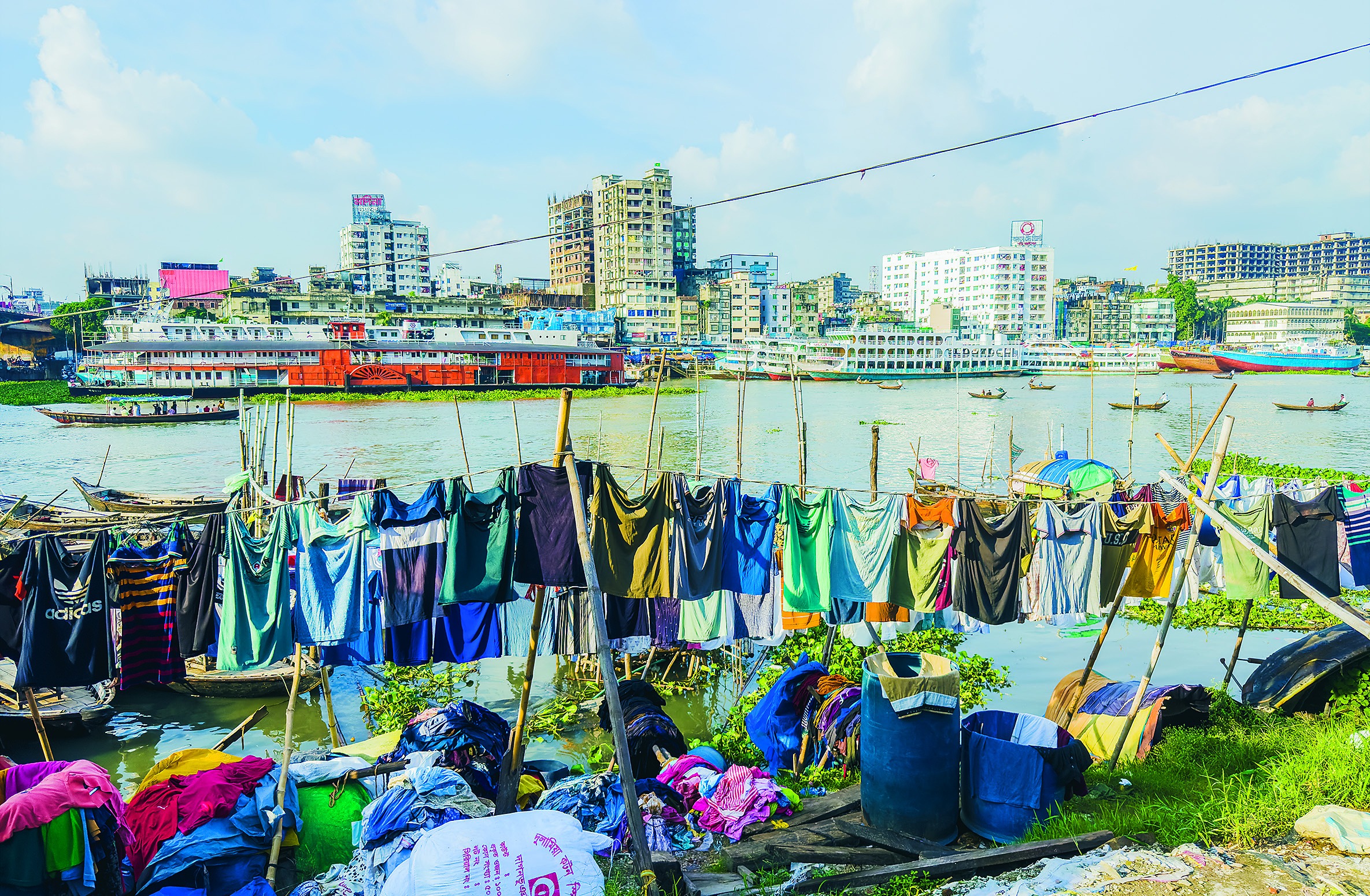
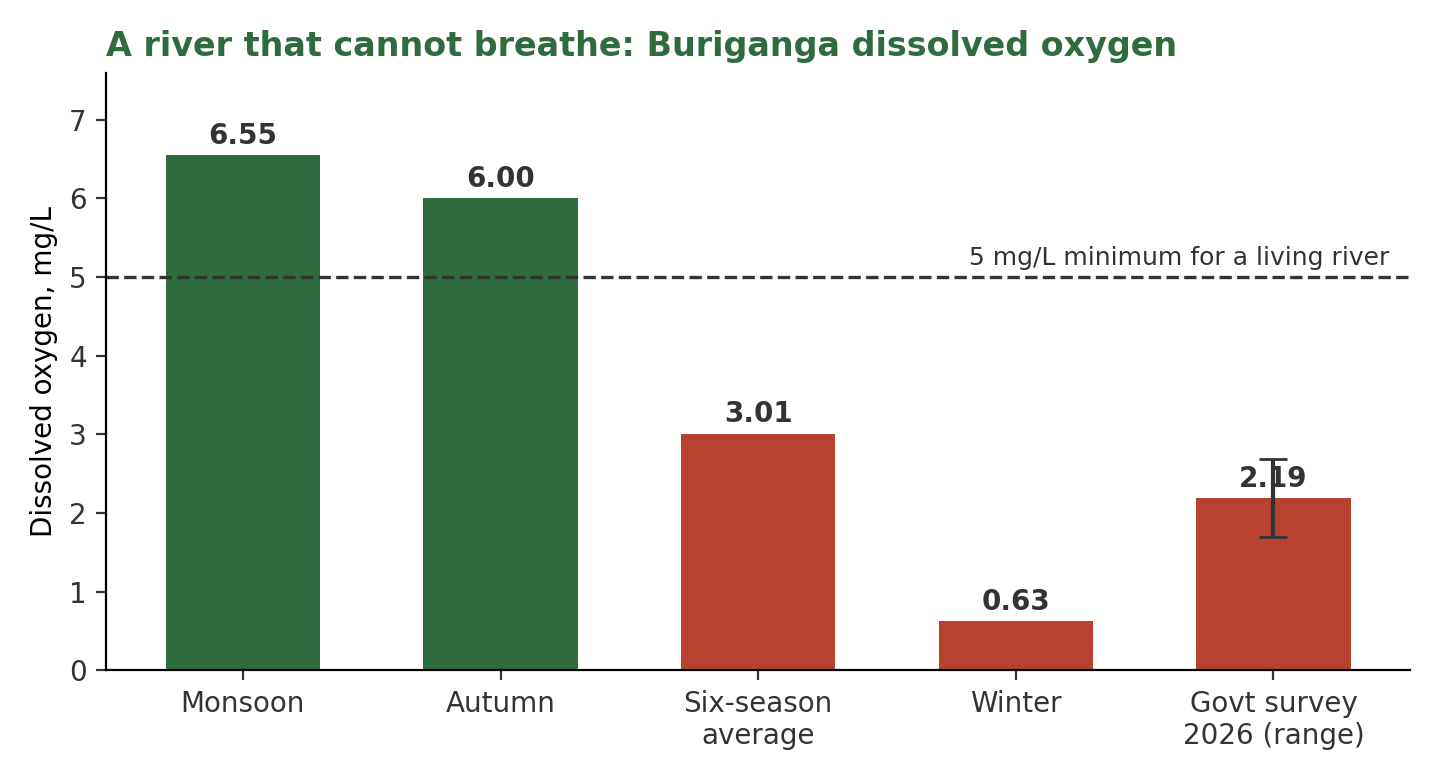
In winter the Buriganga carries 0.63 milligrams of oxygen per litre — an eighth of what a river needs to keep a fish alive, according to a study done by the Center for Atmospheric Pollution Studies (CAPS) in 2022-2023. When I presented a restoration blueprint for the Buriganga and Dhaka's other critical rivers at the United Nations SDG Summit, the situation was already described as dire. It is worse now. The government's own survey presented this August found 224 outlets discharging into the Buriganga and Turag, 55 percent of the load industrial — dyes, chemicals, heavy metals — and the river's oxygen at 1.7 to 2.7 mg/L against a 5 mg/L floor. The World Health Organization's estimate of 60,000 cubic metres of toxic liquid waste entering the river every day has not moved in a decade, because the sources have not.
Source: CAPS six-season study 2022–23 (Daily Sun); government survey presented 13 August 2026 (Dhaka Tribune). Standard: Environment Conservation Rules 2023, 5 mg/L.
The plant without pipes
Dhaka generates roughly 2,000 million litres of sewage a day, carried by 881 kilometers of sewer lines, according to Dhaka WASA. The World Bank's project appraisal put it plainly: almost all of it discharges untreated into canals and rivers. The answer was supposed to be Dasherkandi — South Asia's largest treatment plant, 500 MLD, Tk 3,371 crore, inaugurated in July 2023. Three years on, the government's own evaluation division reports that it treats about 280 MLD in the dry season because the sewer network to feed it was never built; in the monsoon the inflow is mostly stormwater. A plant is not a system. Until trunk sewers reach it, Dhaka has bought a very expensive way of treating rain.
Sources: Dhaka WASA sewage estimate (TBS, 2023); IMED evaluation of Dasherkandi, July 2026 (The Daily Star).
The poison was moved, not stopped
Relocating the tanneries from Hazaribagh to Savar was meant to save the Buriganga. It transferred the effluent to the Dhaleshwari. The estate's central treatment plant took 18.5 years and Tk 938 crore — a 434 percent cost overrun — and still fails the Department of Environment's own benchmarks. It handles about 14,000 cubic metres a day against 35,000 at peak. The consequence is not only ecological: not a single tannery inside the estate holds Leather Working Group certification, so tanners sell hides to China at 45 to 75 cents a square foot and leather exports fell from $1.13 billion in 2012 to $970 million in 2024. Pollution is now the binding constraint on a billion-dollar industry. The ministry's proposal of soft loans for individual plants and a second CETP is the right direction; it needs a date.
Beyond Dhaka: water people can reach, but cannot drink
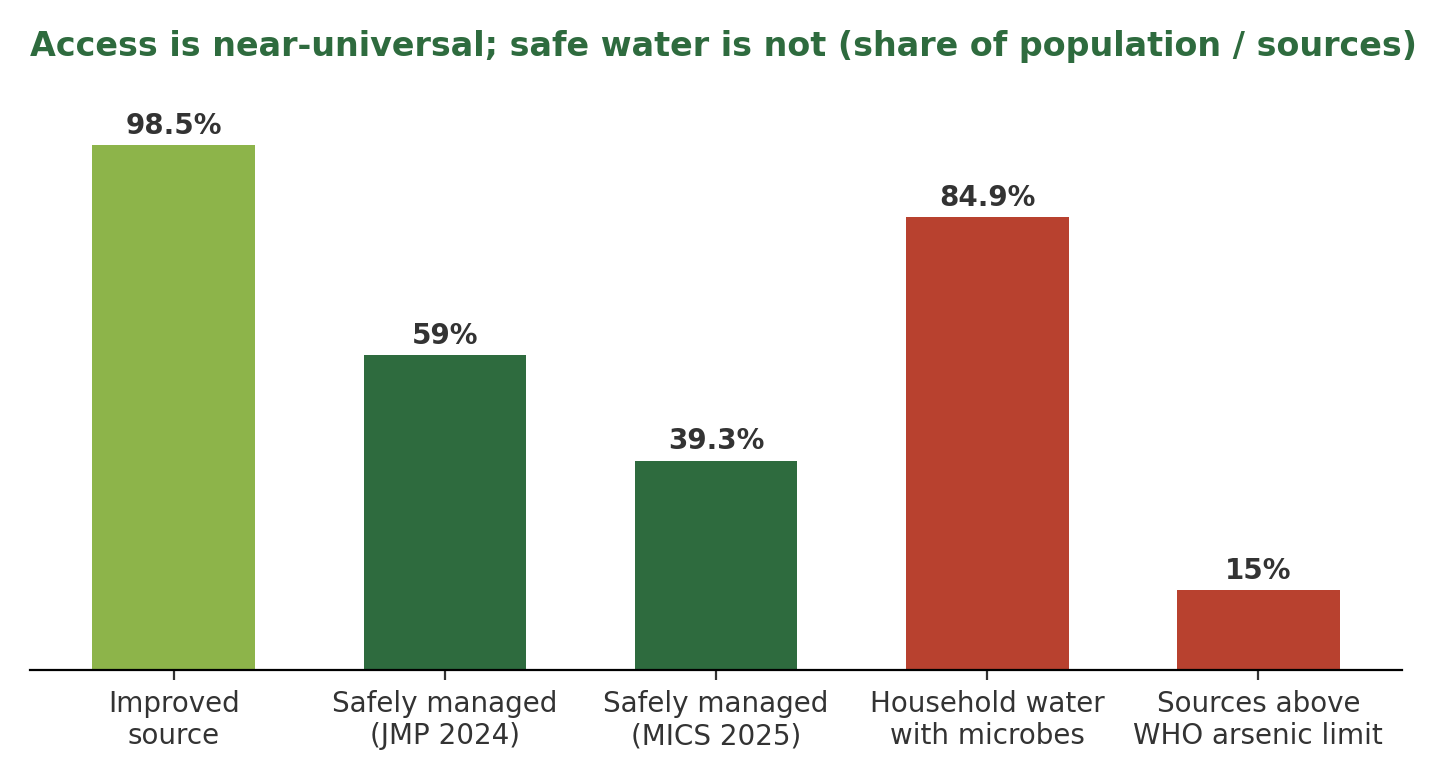
Bangladesh won the access battle — 98.5 percent of households use an improved source — and is losing the quality war. UNICEF's summary of MICS 2025 finds 84.9 percent of household drinking water microbially contaminated, arsenic above the WHO limit in around 15 percent of sources, and safely managed drinking water at just 39.3 percent. The WHO/UNICEF monitoring programme is more generous, 59 percent in 2024, up only three points since 2015 — still 71 million people. Even piped water in Dhaka's affluent neighbourhoods carries E. coli more than 80 percent of the time. Coastal salinity, worsening with sea-level rise, adds a third front.
Sources: UNICEF Bangladesh (MICS 2025); WHO/UNICEF JMP 2025 via WaterAid; improved-source figure from the SWA country overview.
Drinking the aquifer
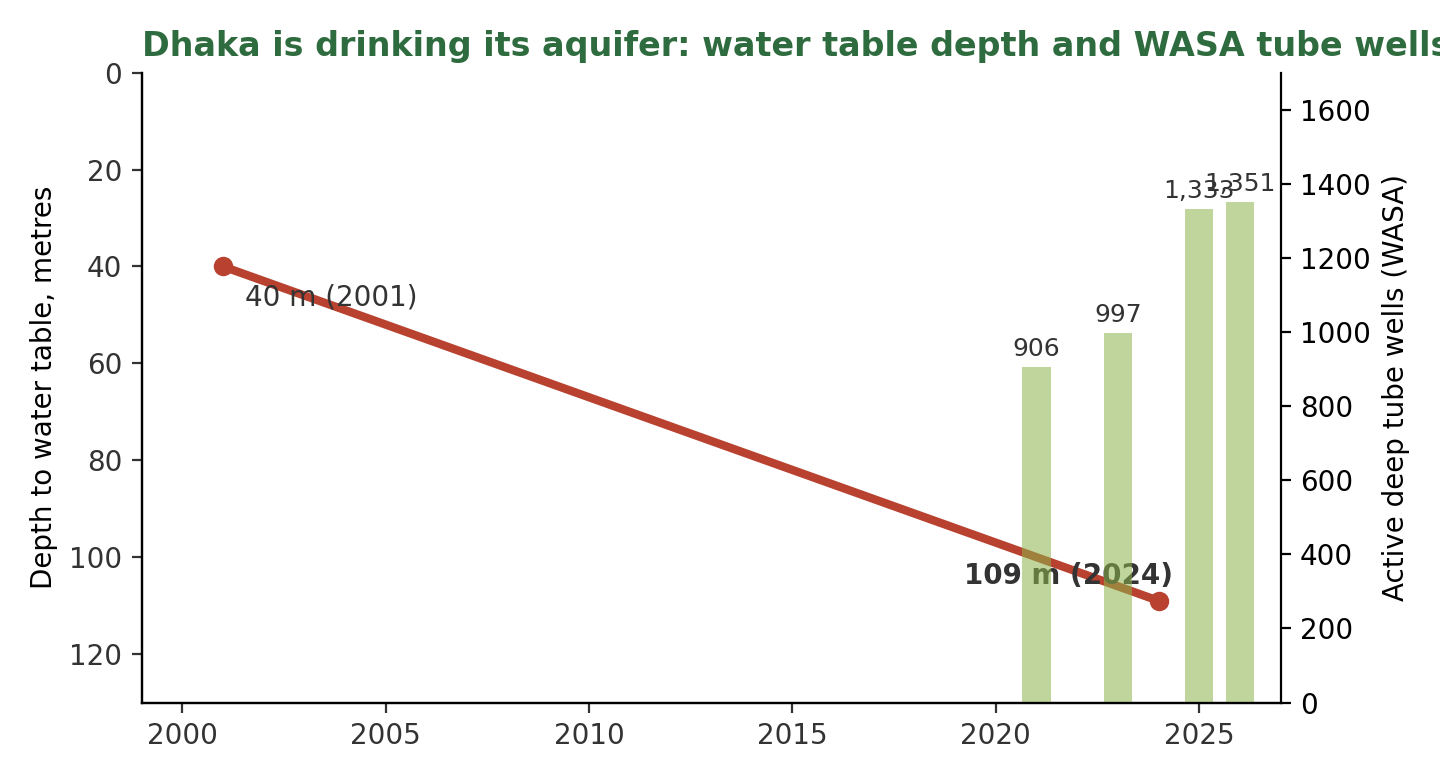
Meanwhile the capital is mining its groundwater. Dhaka WASA draws 74 percent of supply from 1,351 deep tube wells; the water table has fallen from about 40 metres in 2001 to 109 metres in 2024 — three metres a year. The response in January was a Tk 921 crore 'emergency' project to sink more wells while the two surface-water plants meant to end the dependence, Gandharbpur and Saidabad Phase 3, remain unfinished. This is the water-sector equivalent of borrowing to pay interest.
Sources: Dhaka WASA data reported in Dhaka Tribune, July 2026; The Daily Star on the emergency groundwater project.
What government has declared — and why a map is not a clean-up
Credit where due. On 13 August the Environment Minister convened industry and eleven agencies; the Bangladesh Navy tabled an Integrated Action Plan and Implementation Roadmap for the Buriganga and will coordinate it. The Prime Minister's Principal Secretary recalled that the Thames was once as dead as the Buriganga. Days later ECNEC returned a Tk 567 crore Turag project and assigned the Principal Secretary to prepare an integrated master plan for Dhaka's rivers; a clean-up of the Old Buriganga channel began on 21 August. The country's leading newspaper called the 224-outlet map an important and overdue step. It is. But the 2010 Buriganga Restoration Project was also a plan — Tk 944 crore, five extensions, still incomplete a decade on. Plans do not raise oxygen levels. Enforcement does.
What must happen now
Publish the list, start the clock. Name all 224 outlets and their owners this month; give each a 90-day order to close, connect or operate a functioning ETP, with online effluent meters reporting to a public dashboard. The Navy-led roadmap gives the Department of Environment the political cover it has never had.
Build the pipes before anything else. Approve and tender the Dasherkandi trunk-sewer network before December, ring-fence its budget, and publish a quarterly connection count. Every month of delay treats rain instead of sewage.
Put a date on Savar. A twelve-month deadline for the CETP to meet DoE standards, individual ETP loans released against verified pre-treatment, and export incentives conditional on Leather Working Group audit — the certification is the sanction the market already applies.
Stop the emergency well-drilling. Redirect the Tk 921 crore to finish Gandharbpur and Saidabad Phase 3, impose a moratorium on new deep tube wells in central Dhaka, and license every private well.
Treat water quality as the target, not access. A national household water-safety programme — chlorination, arsenic mitigation in the 15 percent of affected sources, and annual MICS-style testing — with safely managed water, not improved sources, as the reported indicator.
Measure in public. Monthly dissolved-oxygen readings for all six rivers around Dhaka, published on one page, and the integrated master plan delivered with a completion date and a named accountable official.
International partners present in Bangladesh — the World Bank, ADB, JICA, China Exim, UNICEF and the UN system — should stop financing pilots and plants that stand alone, co-finance the trunk sewers and the CETP retrofit, and make continued support conditional on the enforcement calendar above. The Thames took a law, decades and a treasury behind it. Bangladesh already has the map, the plant and the estate. What the river lacks is a date — and the will to keep it.