The UN’s Sustainable Development Goals Report 2026 finds just 36% of targets on track worldwide. Bangladesh is one of Asia’s fastest improvers and the world’s leader in green garment factories — and 110th of 169, with not a single Goal on track. All of that is true at once, and the gap is where the next decade will be decided.
THE GLOBAL FRAME: A decade in, progress is real but insufficient
On 7 July 2026 the United Nations published The Sustainable Development Goals Report 2026, the only official UN assessment of the 2030 Agenda, prepared by UN DESA with more than fifty international agencies and data from over 200 countries. Its verdict is unusually plain. Of the 139 targets with trend data, just over a third — 36 per cent — are on track or making moderate progress. Nearly half, 49 per cent, are moving too slowly. Fifteen per cent have slipped below their 2015 baselines.
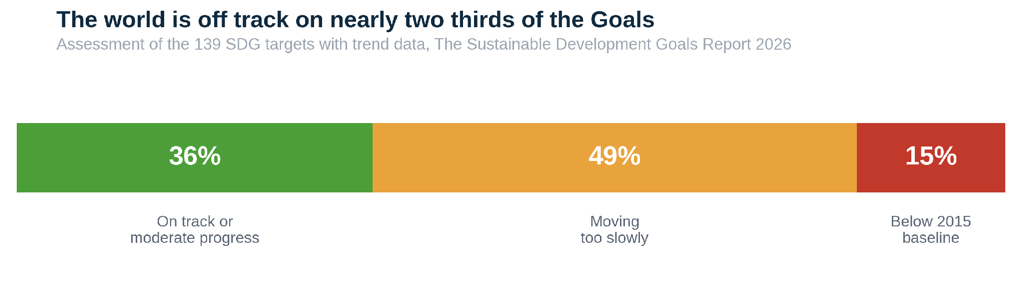
Figure 1 — The world is off track on nearly two thirds of the Goals. Source: The Sustainable Development Goals Report 2026, UN DESA, 7 July 2026.
The gains are not trivial. Since 2015, nearly one billion people have gained access to safely managed drinking water and 1.2 billion to safely managed sanitation. Electricity now reaches 92 per cent of the world’s population, a third of it renewable. Internet access has climbed from 40 to 74 per cent. Social protection covers more than half of humanity for the first time in history.
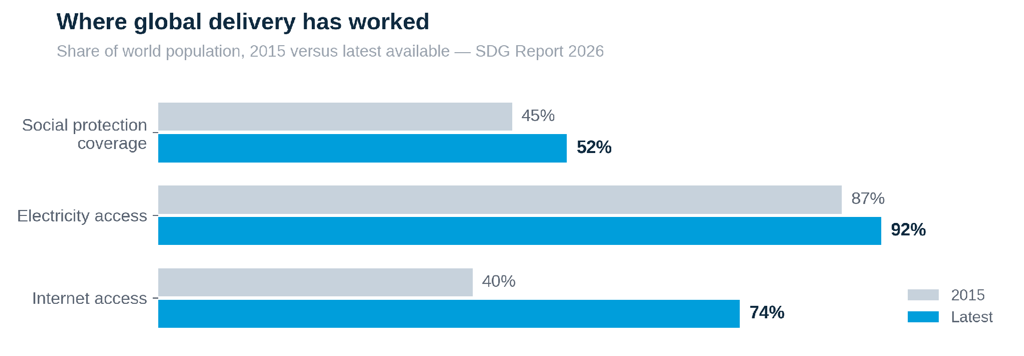
Figure 2 — Where global delivery has worked. Source: The Sustainable Development Goals Report 2026, UN DESA.
The headwinds are equally concrete. In 2025 global temperatures reached 1.43°C above pre-industrial levels and greenhouse gas emissions hit record highs again. Violent conflict displaced 118 million people. Official development assistance fell by a record 23 per cent in a single year. The annual SDG financing gap stands at roughly US$4 trillion.
“The direction we choose now will determine whether the progress of the past decade holds — or unravels.” — António Guterres, Secretary-General of the United Nations
That last figure — a 23 per cent collapse in aid — is where the global picture becomes a national one. For countries whose development finance is largely concessional, the arithmetic of the next four years changed in a single year. Bangladesh is one of them, and it is about to lose more.
THE PARADOX: Two true stories about one country
In the Sustainable Development Report 2026, the Sustainable Development Solutions Network places Bangladesh 110th of the 169 countries it is able to rank, with a score of 64.84 out of 100. Within South Asia that puts the country sixth of eight — behind the Maldives, Bhutan, Nepal, Sri Lanka and India, and ahead of only Pakistan and Afghanistan.
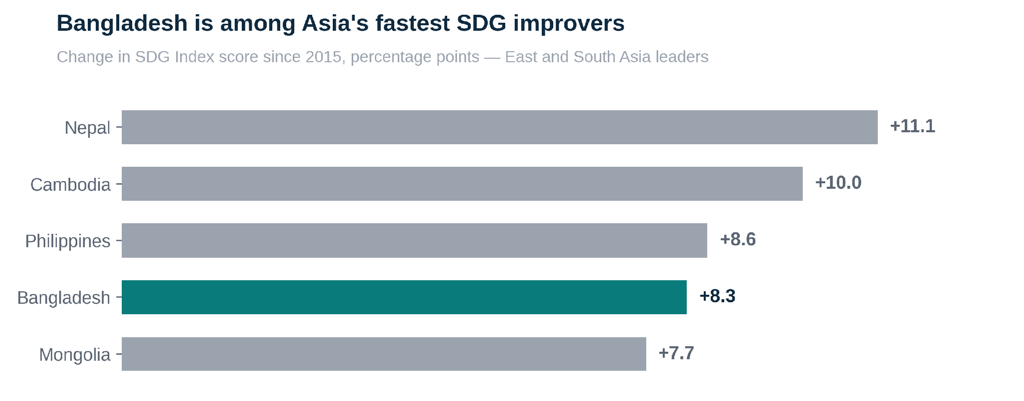
Figure 3 — Bangladesh ranks sixth of eight in South Asia. Source: Sachs et al., Sustainable Development Report 2026, SDSN.
Read alongside the regional table, the earlier edition supplies the other half of the picture. The 2025 report named Bangladesh among the five fastest-improving countries in East and South Asia since 2015, with 8.3 points added to its score. (SDSN cautions that scores are not comparable across editions after methodology revisions, so the two findings should be read as direction and position rather than as a single series.)
Neither finding cancels the other. A country can be moving quickly and still be a long way from where it needs to be, and Bangladesh is the clearest case of that proposition anywhere in the region.
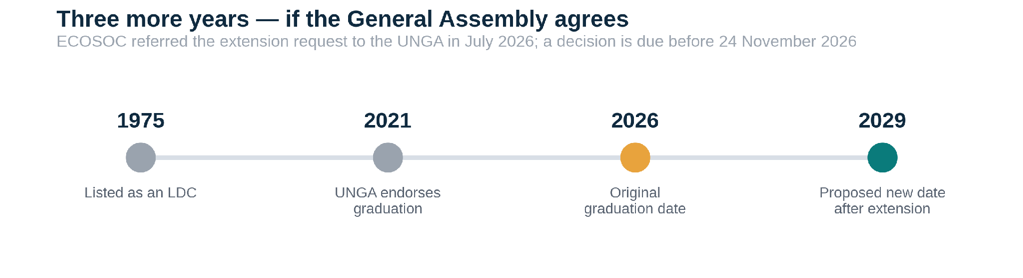
Figure 4 — Bangladesh is among Asia's fastest SDG improvers. Source: Sachs et al., Sustainable Development Report 2025, SDSN.
The uncomfortable detail sits beneath the position. At the global level the UN found only 36% of targets on track. Bangladesh’s own profile is thinner still: on the 2025 assessment just one Goal — SDG 13, climate action — was rated achieved, and that reflects the country’s very low emissions rather than any deliberate accomplishment. It is a ranking earned by not having industrialised, not by having decarbonised.
Bangladesh contributes less than 0.5% of global emissions and is among the most exposed countries on earth. That asymmetry is the moral centre of everything that follows.
THE CLOCK: A three-year reprieve, not a reprieve from reform
The immediate context is a deadline that has just moved. Bangladesh was listed as a Least Developed Country in December 1975 and was scheduled to graduate on 24 November 2026, five decades later. In February 2026 the government asked the UN Committee for Development Policy to extend the preparatory period by three years, to November 2029. The Committee agreed the request was justified, ECOSOC referred it onward by consensus in July, and the General Assembly is expected to decide before the original graduation date.
The Committee's language deserves quoting carefully, because it is the whole argument in one line: the extension should not be viewed as an opportunity to delay reforms — rather, it should serve as a catalyst for accelerating them. The Committee was explicit that Bangladesh continues to exceed all three graduation thresholds by a comfortable margin. The extension is not a rescue. It is time bought at a price, and the price is that the reforms now have a deadline attached.
WHAT GRADUATION WILL REMOVE
- Duty-free, quota-free access to the European Union market
- Special and differential treatment under WTO rules
- Priority access to highly concessional development finance
- Preferential technology transfer and technical assistance
The exposure is concentrated. Bangladesh is the single largest user of LDC support measures, and readymade garments account for roughly four-fifths of export earnings. A country that depends on one sector and one set of trade preferences has, in effect, one hedge — and that hedge expires on a known date.
CHALLENGE 01: An energy transition that has not begun at scale
Renewables sit near 5% of installed capacity. The 2030 target is 20%.
If there is a single number that should worry policymakers, it is this: renewables account for about 5.4% of installed electricity generation capacity. Fossil gas supplied roughly 55% of primary energy supply and around four-fifths of electricity generation. The Renewable Energy Policy targets 20% by 2030. The third Nationally Determined Contribution, submitted to the UNFCCC in September 2025, sets 25% of the power mix by 2035.
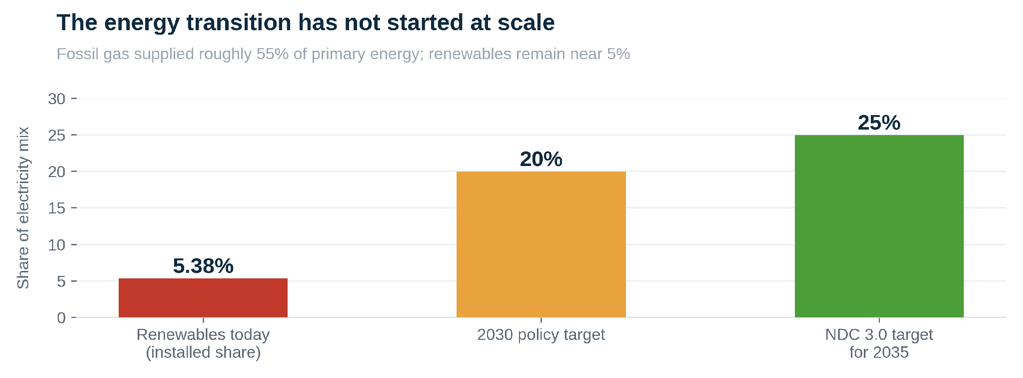
Figure 6 — The energy transition has not started at scale. Source: SREDA installed-capacity data; Renewable Energy Policy 2025; Bangladesh NDC 3.0 (UNFCCC, September 2025).
The distance between 5.4% and 20% in four years is not a policy gap; it is an implementation gap. Rooftop solar tenders have repeatedly drawn thin responses — one recent round attracted bidders for only 22 of 55 sites — because of unresolved risk allocation, rigid pricing and weak incentives. The capital exists globally. What is missing is a bankable structure that lets it land.
NDC 3.0 itself is candid about scale: the unconditional target is a 6.39% reduction against business-as-usual by 2035, with 13.92% conditional on international support. Delivering the unconditional portion alone is costed at roughly US$26 billion. Energy was the largest single source of emissions in the 2022 base year, at 123.01 MtCO2eq, or 48.81% of the national total.
CHALLENGE 02: Adaptation ambition meets adaptation finance
The plans are world-class. The concessional finance to deliver them is narrowing.
Bangladesh has done the planning work. The National Adaptation Plan runs to 2050, the Delta Plan to 2100, and the climate strategy dates to 2009. Few countries at comparable income levels have this depth of adaptation architecture. The constraint is not analysis. It is money, and the terms on which it arrives.
This is where LDC graduation and climate vulnerability collide. The same transition that signals development success also narrows access to concessional finance — precisely as adaptation costs rise. A country that contributes less than half a percent of global emissions will be asked to borrow at closer to market rates to defend itself against warming it did not cause. Resolving that contradiction is a task for the international system, not for Dhaka alone, and it deserves to be argued loudly at every COP.
OPPORTUNITY 01: Where Bangladesh already leads the world
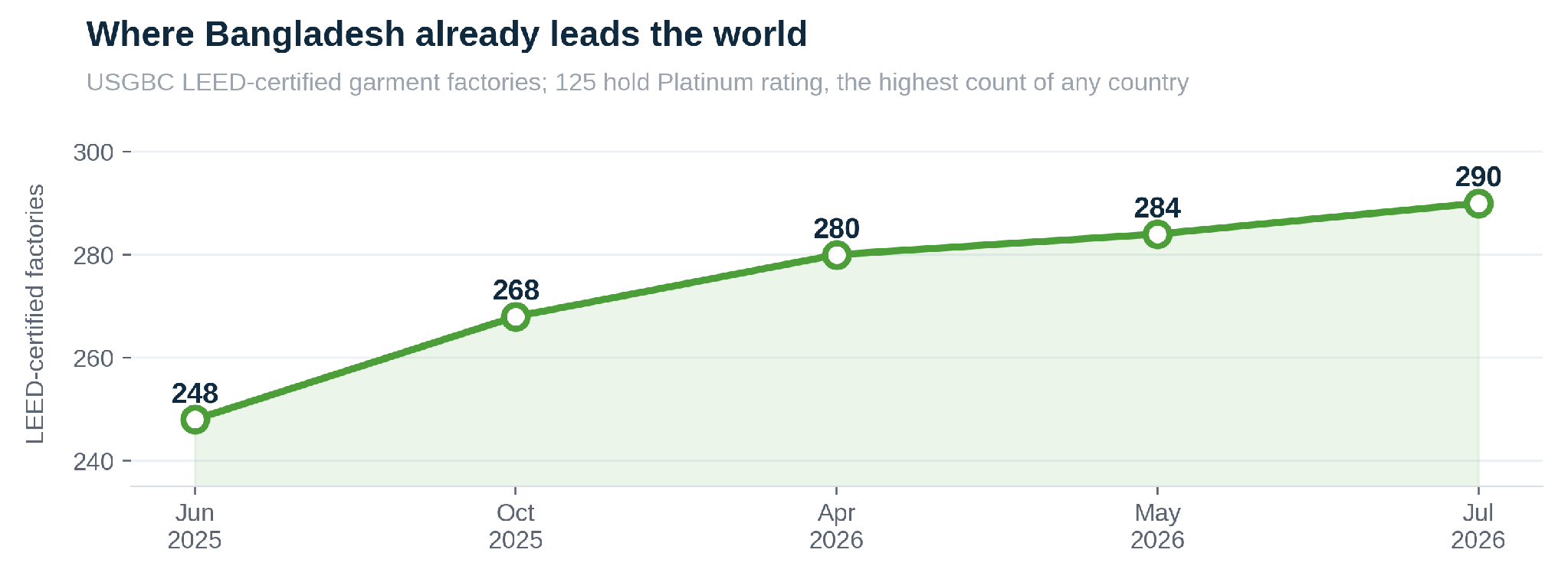
290 LEED-certified garment factories — more than any other country on earth.
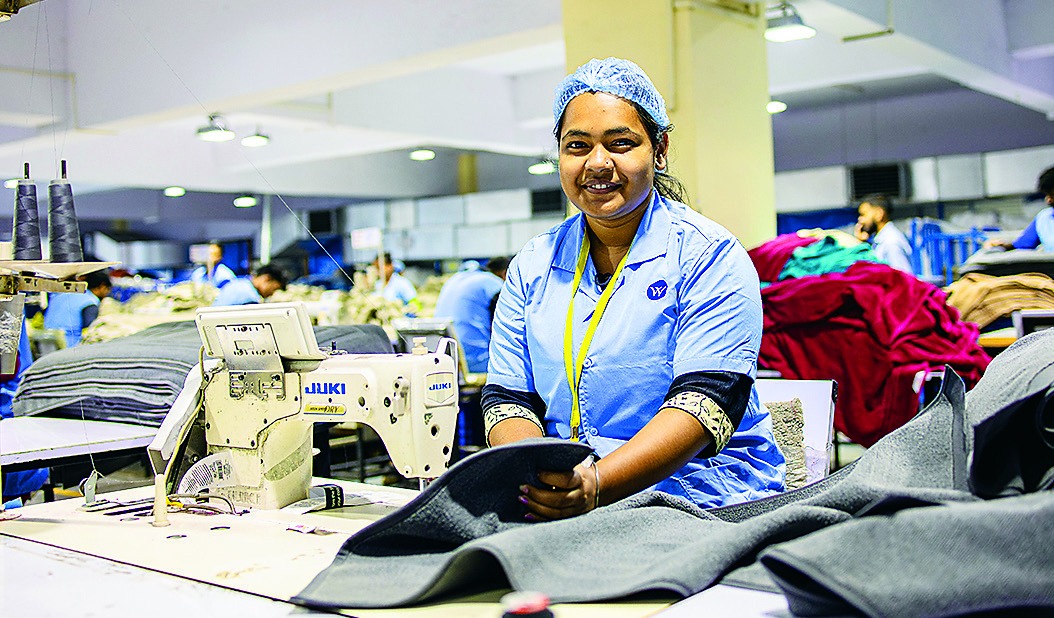
Against that difficult backdrop stands an achievement that is genuinely without parallel. Bangladesh has 290 LEED-certified garment factories — more than any other country on earth. Of these, 125 hold Platinum, the highest rating the US Green Building Council awards. Fifty-three of the world's hundred highest-scoring LEED factories are Bangladeshi. In January 2026, Hams Garments in Gazipur scored 108 out of 110, a world record.
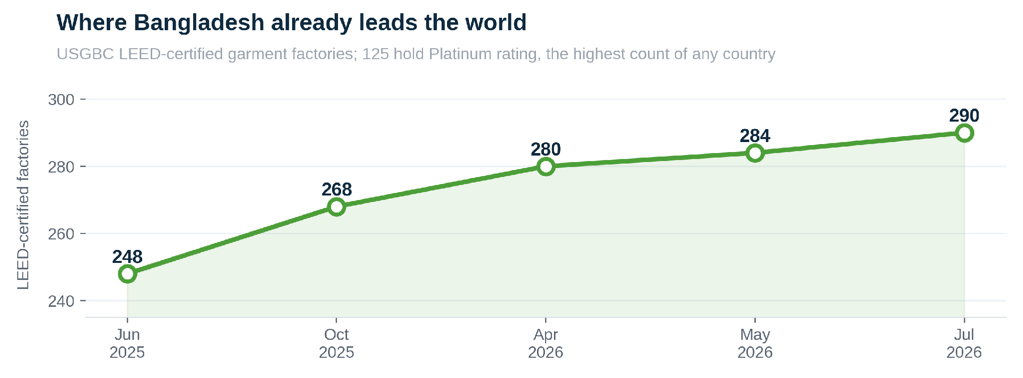
Figure 7 — Where Bangladesh already leads the world. Source: BGMEA and USGBC certification records, June 2025 – July 2026.
A country routinely described by its vulnerabilities has quietly built the greenest garment manufacturing base in the world. That is not a talking point. It is an export strategy.
The strategic significance is easy to miss. As the EU Green Deal, the Corporate Sustainability Reporting Directive and carbon border measures tighten, verified environmental performance stops being a marketing asset and becomes a market-access requirement. Bangladesh has, largely through private-sector investment, pre-positioned itself for a regulatory regime that has not fully arrived. Very few developing economies can say that about any sector.
The task now is to convert a building-certification story into a supply-chain story. LEED certifies structures. It does not decarbonise the grid that powers them, nor the dyeing and finishing processes that dominate the sector's water and chemical footprint. The next milestone is not the 300th certified factory; it is the first credible, audited Scope 3 disclosure across a Bangladeshi supply chain.
OPPORTUNITY 02: The missing layer — measurement and skills
A decade ago half of all SDG indicators lacked data. Bangladesh has not closed its share of that gap.
Across two decades of work on sustainability reporting, in Bangladesh and elsewhere, I have come to a plain conclusion. The binding constraint in most developing economies is not ambition, and it is not even capital. It is measurement. Institutions cannot manage what they have never counted, and they cannot attract climate finance against numbers they cannot defend.
The UN makes the same point from the other direction. A decade ago data were missing for half of all SDG indicators; today a global database of more than three million data points covers nearly every one, which is what allowed the 2026 report to be so specific. Bangladesh has not fully shared in that gain — 2% of its SDG Index data is simply missing, and nine Goals sit in a stagnating category that, in practice, often means unmeasured rather than unmoving. Every unverified claim raises the risk premium a lender applies.
WHAT A MEASUREMENT LAYER REQUIRES
- A named owner for every indicator, in every institution — not a committee
- An evidence rule: no claim published without a traceable source
- Baselines built before targets are set, not after
- Green-skills curricula that produce the auditors, analysts and engineers the transition needs
This is why education sits at the centre of the agenda rather than at its edge, and why the UNESCO Chair I hold is framed around education for sustainable development, green skills and climate action. A national target for renewable energy is only as good as the number of people who can finance, build, operate and verify it. Bangladesh's universities are where that workforce is made or is not.
THE AGENDA: Five things the next three years must deliver
- Make the energy target bankable. Fix risk allocation, pricing and offtake terms before announcing further capacity targets. The 2030 goal now requires roughly a fourfold increase in renewable share in four years.
- Diversify beyond garments — deliberately. Four-fifths of exports in one sector is a structural vulnerability that graduation will expose, not create.
- Build the national measurement layer. Close the data gaps that keep nine Goals in the stagnating column and inflate the cost of every loan.
- Take the green-factory advantage up the value chain. Move from certified buildings to audited supply-chain emissions, and negotiate on that basis with EU buyers.
- Argue the finance case internationally. Graduation must not become a penalty for a country carrying climate risk it did not generate. That argument has to be made in New York, Bonn and every COP.
A country that is running, but not yet arriving
Bangladesh has added 8.3 points to its SDG score in a decade, brought electricity to essentially the whole population, and built the world's greenest garment manufacturing base. It also sits 110th of 169 on the SDG Index, sixth of eight in South Asia, with an energy transition still largely on paper. It has been given three more years, if the General Assembly agrees, and the Committee that recommended them said plainly what they are for.
The next three years will not be decided by ambition. Bangladesh has never lacked ambition. They will be decided by whether the country can measure what it does, prove what it claims, and finance what it has already planned. Those are unglamorous tasks. They are also the ones that separate a fast improver from a country that actually arrives.