


What is ESG?
Environmental, Social, and Governance (ESG) factors are vital for evaluating companies beyond traditional financial metrics like revenue and profit, as stakeholders increasingly demand transparency on societal and environmental impacts. ESG ratings assess these non-financial dimensions and risks, influencing investments and corporate reputations. However, because rating agencies use varying methodologies and data sources, these ratings can differ significantly, making a solid understanding of them essential for interpreting corporate sustainability.
What are ESG Ratings?
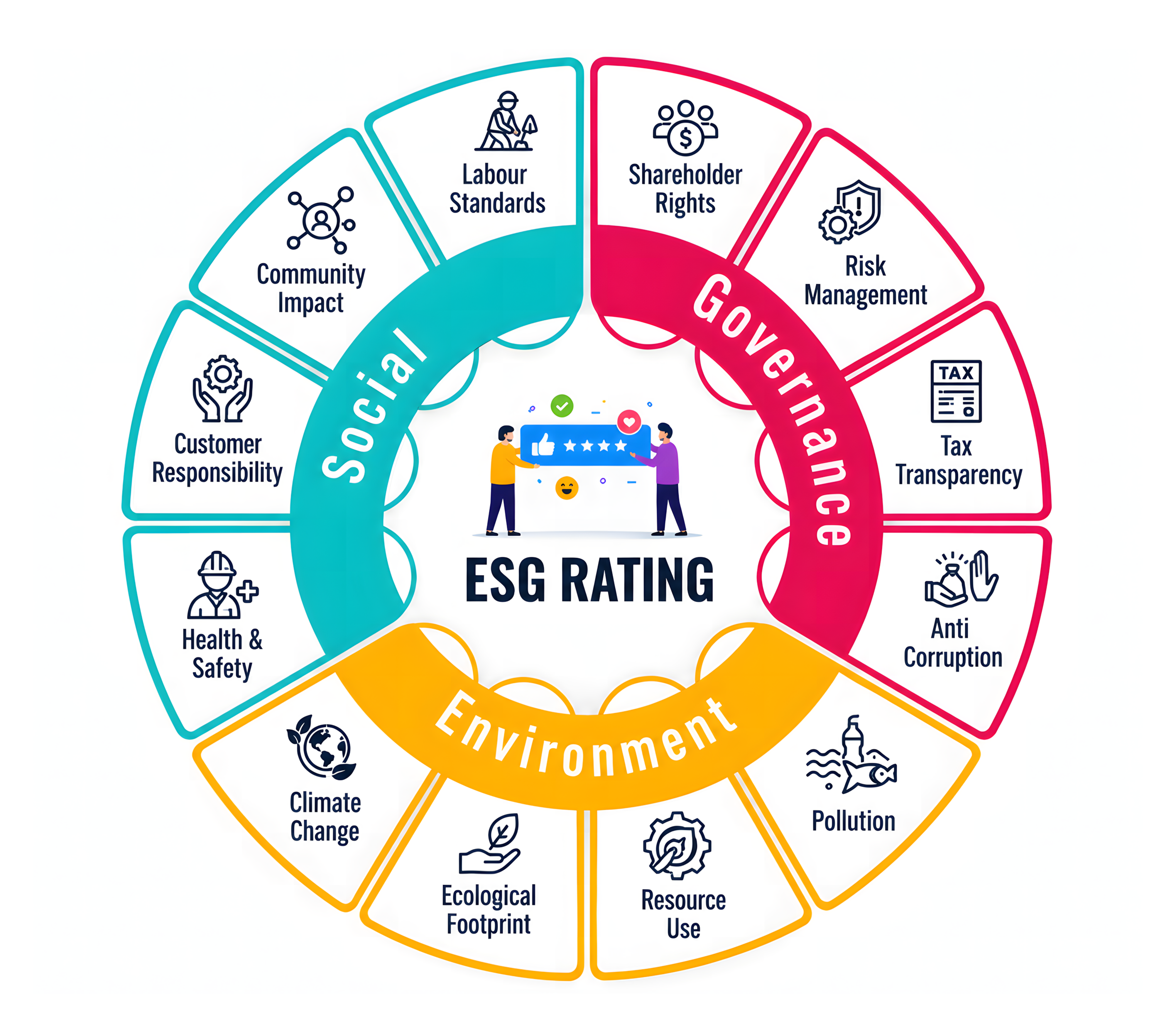
An ESG rating is an assessment of a company's performance or risk profile across three broad dimensions: Environmental, Social and Governance.
The Environmental dimension examines how a company affects and depends on the natural environment. Common factors include greenhouse-gas emissions, energy consumption, climate-change strategy, waste management, pollution, water use, biodiversity and resource efficiency. For a manufacturing company, for example, carbon emissions and waste may be particularly important, while for a financial institution the environmental assessment may focus more heavily on the environmental risks associated with its lending and investment activities.
The Social dimension considers how a company manages relationships with employees, customers, suppliers and communities. Topics may include working conditions, employee health and safety, diversity and inclusion, human rights, data privacy, product safety and supply-chain standards. A company can therefore face significant social risks even if its direct environmental impact is relatively small.
The Governance dimension evaluates how a company is directed and controlled. It commonly includes board structure and independence, executive remuneration, shareholder rights, business ethics, anti-corruption measures, tax practices, risk management and transparency. Governance is particularly important because weaknesses in corporate governance can increase the likelihood of fraud, misconduct or poor strategic decisions.
ESG ratings combine information from these and other areas into an overall assessment. However, there is no single universal ESG rating methodology. Different providers may answer different questions. Some primarily measure a company's exposure to financially material ESG risks, while others place greater emphasis on the company's impact on society and the environment.
How are Corporates Rated?
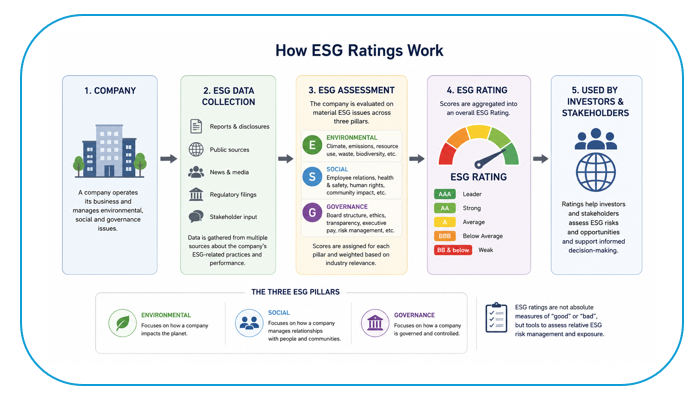
Although methodologies differ, the ESG rating process generally involves several stages.
Defining the Relevant ESG Issues
Identifying which ESG issues matter most to a company or industry is the first step, as risks vary significantly across sectors.
For instance, a mining company faces scrutiny over environmental impacts, worker safety, and community relations. Technology firms focus on data privacy, cybersecurity, and AI governance, while banks are judged on governance, responsible lending, and financing risks. Because of these distinct profiles, companies are typically assessed relative to their peers rather than a universal checklist.
Collecting Data
Rating providers gather vast data from reports, filings, websites, databases, and news, alongside direct management engagement and controversy tracking. However, data quality and availability vary widely; large corporations disclose much more than smaller ones, meaning ESG ratings often reflect differing disclosure practices rather than actual sustainability performance.
Measuring ESG Indicators
The collected information is converted into quantitative indicators. These may include metrics such as carbon intensity, employee turnover, workplace accidents, board independence or the existence of anti-corruption policies.
Rating agencies then determine how important each indicator is. The weighting can differ substantially between providers. One methodology may place greater emphasis on climate-related risks, while another may give greater importance to social controversies or corporate governance.
Adjusting for Industry and Risk Exposure
ESG rating systems recognize that companies face varying levels and types of risk depending on their industry. Consequently, a carbon-intensive company does not automatically receive a poor score; instead, its management of environmental risks is evaluated relative to relevant peers.
This establishes a key distinction: a company with a heavy environmental footprint can still earn a strong ESG risk rating if it deploys sophisticated systems to manage that exposure.
Producing the Final Rating
Finally, the individual indicators are aggregated into scores or ratings. Providers use different scales, such as numerical scores, letter grades or categories ranging from low to high risk.
The rating is intended to provide users with a simplified assessment of a company's ESG profile. However, the final score is only as meaningful as the methodology and data behind it.
Why Do ESG Ratings Matter?
ESG ratings matter because they can affect how companies are perceived and how capital is allocated.
Investment Decisions
Institutional investors, pension funds, and asset managers utilize ESG ratings in investment management to select securities, manage portfolios, and assess risks. Investors integrate ESG considerations by excluding non-compliant companies, targeting those positioned for long-term sustainability, or incorporating the data into fundamental financial analysis. The core premise is that ESG factors have direct financial implications—such as regulatory compliance costs, reputational damage from poor labor practices, or fraud risks from weak governance—thereby providing transparency into risks often hidden in standard financial statements.
Access to Capital
The growth of sustainable and ESG-labelled investment products has further increased the importance of corporate ESG information. Companies seeking to attract sustainability-focused investors may therefore have incentives to improve both their actual practices and the quality of their disclosures.
Corporate Reputation
ESG ratings can influence how a company is perceived by customers, employees, investors and other stakeholders. A strong ESG profile may support a company's reputation as a responsible and forward-looking organisation.
This is particularly relevant in sectors where consumers are sensitive to issues such as climate change, labour rights, ethical sourcing or data privacy. At the same time, a poor rating or a major ESG controversy can create reputational risks.
However, reputation also creates a risk of greenwashing. Companies may be tempted to communicate sustainability achievements more strongly than their underlying performance justifies. ESG ratings can help provide independent assessment, but they cannot completely eliminate this problem.
Strategic Management
ESG ratings influence internal management by establishing clear metrics that simplify monitoring and strategic decision-making. When a company identifies high carbon emissions or weak governance as material risks, it can proactively implement energy efficiency measures, strengthen board oversight, or improve whistleblower protections. Consequently, ESG ratings serve as vital internal management tools rather than mere external assessments.
The Problems and Limitations of ESG Ratings
Despite their growing importance, ESG ratings have significant limitations.
The first is lack of standardisation. Two reputable ESG rating providers can assign very different assessments to the same company. This does not necessarily mean that one provider is wrong. Rather, they may measure different concepts or use different assumptions about what matters most.
Another problem is the distinction between risk and impact. Some ratings primarily ask whether ESG issues could negatively affect the financial value of a company. Others place more emphasis on the company's impact on people and the planet. A company can therefore perform well under one approach while appearing less sustainable under another.
Data quality is another major issue. ESG information is often incomplete, estimated or voluntarily disclosed. Companies may report their performance using different boundaries and assumptions, making comparisons difficult. Smaller companies may also have fewer resources available for ESG reporting than large multinational corporations.
There is also a risk of rating shopping or strategic disclosure. If companies know which indicators rating agencies value, they may focus their reporting on metrics that improve their rating without necessarily addressing the most significant underlying problems.
Finally, a single ESG score can create a false sense of precision. Reducing complex issues such as climate change, human rights and corporate governance to one number may make comparison easier, but it can hide important details. Investors and other stakeholders should therefore examine the underlying methodology and individual ESG factors rather than relying solely on an overall score.
The Increasing Importance of ESG Regulation and Reporting
The ESG landscape is also changing because governments and regulators are introducing more detailed sustainability reporting requirements. The aim is to improve the quality, comparability and reliability of corporate sustainability information.
In Europe, for example, sustainability reporting has become increasingly integrated into the corporate reporting framework. The European Union's Corporate Sustainability Reporting Directive (CSRD) introduced more extensive sustainability reporting requirements for companies within its scope. Such developments are intended to make sustainability information more consistent and useful to investors and other stakeholders.
Greater regulation could reduce some of the inconsistencies associated with ESG ratings by improving the underlying data. At the same time, it does not eliminate methodological differences between rating providers. Standardised reporting can improve the information available to analysts, but rating agencies still have to decide how different ESG factors should be assessed and weighted.
Conclusion
ESG ratings are vital tools for evaluating how companies manage environmental, social, and governance issues, influencing investments, financing, reputation, and strategy. However, because different agencies use varying methodologies and focus areas—such as financial risk versus societal impact—ratings for the same company can differ significantly.
Rather than viewing a score as a definitive verdict, investors and managers should use ESG ratings as one of multiple information sources. This involves analyzing the underlying methodology, examining material issues, reviewing raw data, and comparing reported policies with actual corporate behavior. ESG ratings drive value by fostering transparency, identifying long-term risks, and supporting well-informed decisions as sustainability reporting becomes increasingly regulated and financially critical.
Ultimately, the importance of ESG ratings lies not in the score itself, but in the information and incentives surrounding it. When used carefully, ESG ratings can encourage greater transparency, help identify long-term risks and support better-informed corporate and investment decisions. As sustainability reporting becomes increasingly regulated and financially relevant, understanding how ESG ratings work will remain essential for companies, investors and other stakeholders.
Further Reading:
Berg, F., Kölbel, J. F., & Rigobon, R. (2022). Aggregate Confusion: The Divergence of ESG Ratings. Review of Finance, 26(6), 1315–1344
OECD (2025). Behind ESG Ratings: Unpacking Sustainability Metrics, OECD Publishing
European Commission (2022): CSRD (Directive 2022/2464): Corporate sustainability reporting obligations and ESRS compliance
KPMG (2026): Sustainability reporting in the EU, KPMG Publishing
Morningstar Sustainalytics. ESG Ratings Process; https://www.sustainalytics.com/morningstar-sustainalytics-ratings-transparency/ratings-process-archive