Plastics Everywhere - How Do We Manage Them?
Plastic is difficult to avoid in everyday life. It protects food, carries household products, and supports supply chains. But once used, responsibility for it becomes unclear: Who collects it? Who pays for the collection? Where does it go, and can it be recycled?
These questions are increasingly important for Bangladesh. As plastic consumption grows, so does the challenge of collecting, sorting, and recycling waste. Local authorities, waste workers, and communities have traditionally borne this burden, while producers faced limited accountability.
Extended Producer Responsibility (EPR) changes this by holding companies accountable for products beyond the point of sale.
In August 2026, Bangladesh gazetted the Extended Producer Responsibility Guideline for Plastic Waste Management, 2026, establishing clear obligations for companies introducing plastics domestically to manage post-use collection and recycling.
Under the overall leadership of the Ministry of Environment, Forest, and Climate Change, the policy emerged from extensive technical work steered by the Department of Environment, with support from UNIDO and funding from the Norwegian Government under the Integrated Approach Towards Sustainable Plastics Use and Marine Litter Prevention in Bangladesh project. Through multi-stakeholder consultations, the process addressed how EPR must adapt to local market dynamics, collection structures, waste actors, and recycling capacity.
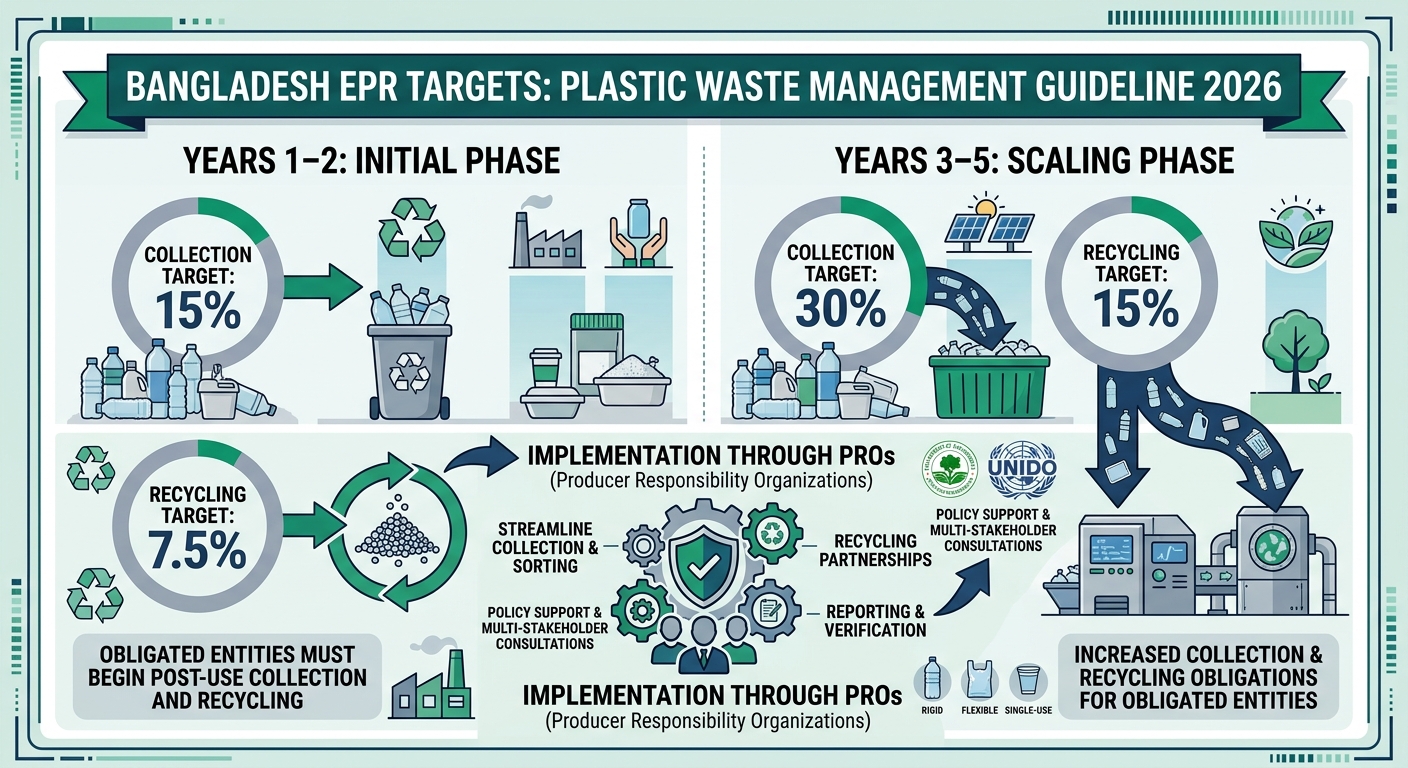
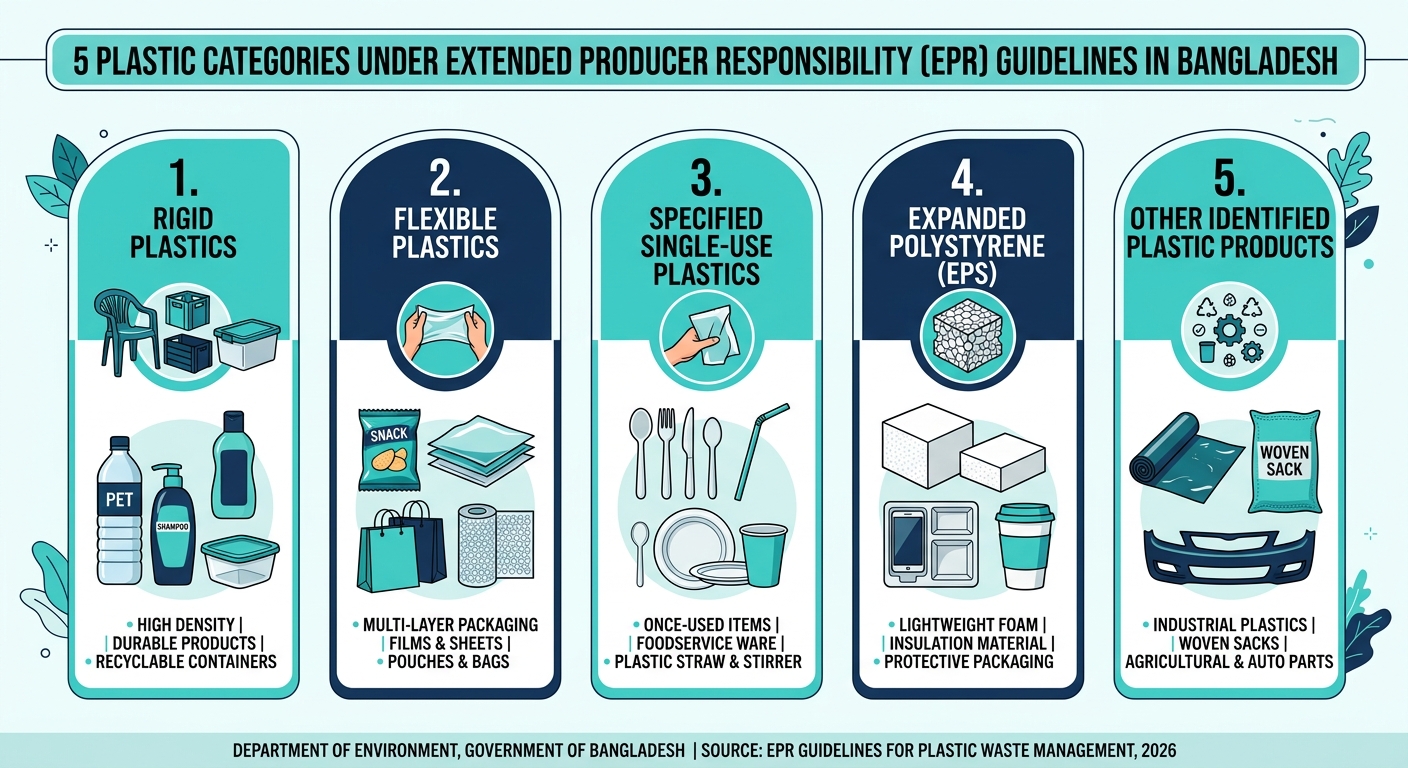
Bangladesh’s Guideline covers five plastic categories, including rigid, flexible, specified single-use, expanded polystyrene, and other identified products. It sets clear compliance targets: obligated entities must collect 15% and recycle 7.5% of waste during years 1–2, rising to 30% and 15% in years 3–5.
Businesses can meet these obligations individually or collectively through Producer Responsibility Organizations (PROs) to streamline collection, sorting, recycling, and reporting.
How Does the EPR Work
However, execution hinges on credible data. To verify targets, authorities need transparent metrics on market volume, collection, and processing. Consequently, the Guideline mandates action plans, record keeping, annual reporting, monitoring, and verification.
While the EPR framework has been gazetted, implementation will require concrete action from obligated entities, including registration, planning, record-keeping, and progress reporting, alongside rigorous government oversight. Without reliable data, EPR risks becoming a check-box exercise rather than actual material recovery.
Infrastructure is another major hurdle. Collecting plastic yields little benefit without adequate sorting and processing capacity, demanding growing investment in collection networks, segregation, advanced recycling, and end-markets.
Consequently, UNIDO addresses EPR within a broader circular framework. Beyond policy, its initiatives cover cleaner production, eco-design, and value-chain integration—recognizing that end-of-life outcomes are largely dictated during early product design.
Human Dimension
Implementation also carries an essential human dimension. Bangladesh's recycling landscape does not start from scratch: informal waste collectors, sorters, traders, and recyclers already perform a vital economic and environmental service by recovering materials from streets, markets, and disposal sites.
The EPR Guideline explicitly recognizes informal actors, providing scope for their integration through Producer Responsibility Organizations (PROs). As the sector formalizes, implementation must focus on connecting existing informal networks rather than displacing them.
This integration can offer informal workers predictable PRO relationships, formal recognition, safer working conditions, and stronger value-chain inclusion. Far from just a social consideration, leveraging the existing expertise and networks of informal workers is a practical necessity for effective waste collection.
Long-Term Opportunity Extends beyond Better Waste Collection
When businesses remain responsible for products after they are sold, decisions made before a product reaches the market begin to matter differently. How much material is being used? Is the packaging easy to collect and recycle? Could recycled material replace virgin material? Could the product or package be redesigned so that less waste is created in the first place?
This is where EPR connects environmental policy with industrial development.
A functioning EPR system can create demand for better collection, sorting, recycling and traceability. That, in turn, can create opportunities for investment in recycling technologies, stronger markets for recovered materials and new partnerships between producers, recyclers and service providers. Over time, it can also encourage businesses to consider material efficiency and circularity as part of production decisions rather than treating waste solely as an end-of-pipe problem.
Consumers remain important to this transition. Producer responsibility does not remove individual responsibility. Separating waste, using appropriate collection systems and participating in take-back, buy-back or deposit-refund arrangements can determine whether discarded materials actually return to the recycling chain.
For UNIDO, this connection between environmental responsibility and industrial transformation is particularly relevant. Bangladesh's experience shows that EPR is not simply about introducing another environmental requirement. For it to work, producers need practical mechanisms to meet their obligations, recyclers need viable markets and technology, regulators need reliable information, consumers need accessible systems, and people already earning their livelihoods from waste need a meaningful place in the transition.
Bangladesh now has a framework for bringing these pieces together. Gazetting the Guideline is therefore an important milestone, but it is not the final measure of success.
The Critical Questions
We are yet to find answers to these critical questions:
Can plastic flows be reliably measured?
Can producers collaborate effectively while retaining individual accountability?
Will recycling infrastructure and secondary markets scale alongside rising targets?
Will reporting and financing remain transparent? and,
Can formalization integrate and empower—rather than displace—the informal waste pickers and enterprises already recovering value?
Getting these dynamics right elevates EPR beyond discarded plastic management. It positions Bangladesh to keep materials in high-value circulation, fortify its domestic recycling value chain, and decisively mitigate the environmental burden of plastic waste.
The Guideline has established the governance framework. The imperative now is translating regulatory intent into an operational system that delivers.